
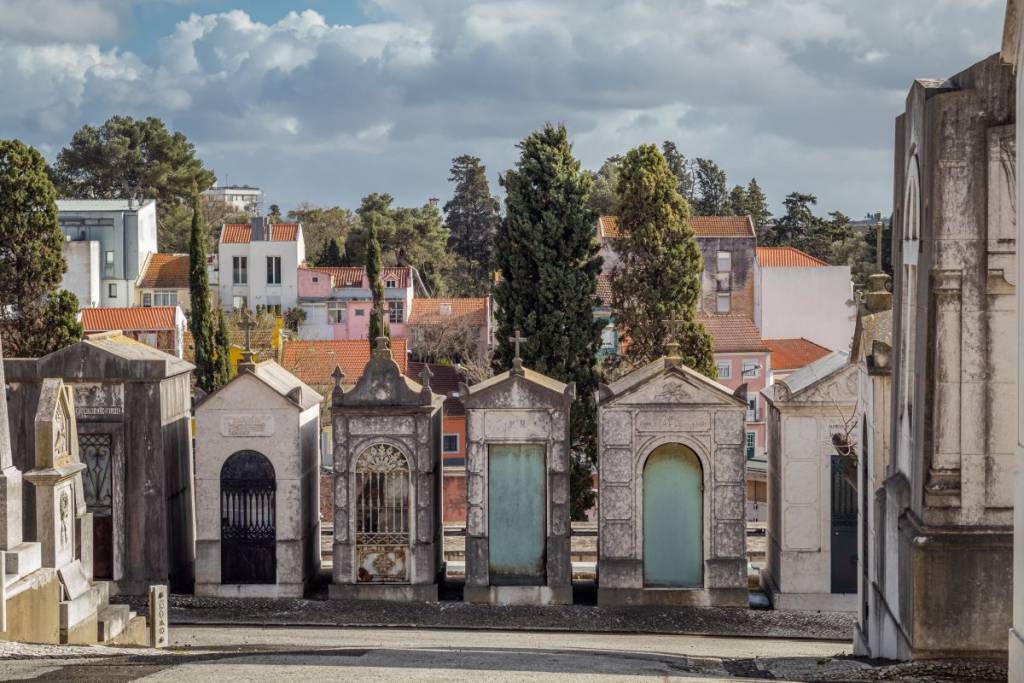

With All Saints’ Day just around the corner, the cemeteries are filling up once again. But there is one in Lisbon that, throughout the year, also welcomes those who go there just to stroll: the Prazeres Cemetery, at the end of the No. 28 tram line. It was born out of an epidemic, is the final resting place of two of the greatest figures in Portuguese culture, and is today described by Turismo de Lisboa as “the only open-air museum in Lisbon.”
A cemetery born of cholera
In 1833, with the city grappling with a cholera epidemic, Lisbon needed a new place to bury the dead. Thus, this cemetery was established in the Estrela neighborhood, where it now covers approximately 12 hectares.
Fernando Pessoa was buried here on December 2, 1935, two days after his death. He remained at Prazeres for half a century: it wasn’t until 1985, on the 50th anniversary of his death, that his remains were transferred to the Jerónimos Monastery, according to the Casa Fernando Pessoa.

Amália Rodrigues, who died on October 6, 1999, was also buried at Prazeres until she was moved to the National Pantheon on July 8, 2001. The writer Aquilino Ribeiro followed the same path. Among the many who remain there are Mário Cesariny, Vasco Santana, and Raul Solnado.
The largest private mausoleum in Europe
Among the rows of tombs, one stands out for its size: that of the Dukes of Palmela, built in the mid-19th century and considered the largest private mausoleum in Europe. In addition to the dukes, family members, friends, and even household servants are buried there, according to Turismo de Lisboa.
An open-air museum
For generations, Lisbon’s prominent families sought tombs befitting their status and commissioned artists to design and sculpt them, which is why a stroll through the cemetery feels like walking through an art gallery. The landscape is dominated by cypress trees: according to Turismo de Lisboa, it is “the largest and oldest grove of cypress trees on the Iberian Peninsula.”
In the chapel, a small museum section houses crucifixes, ceramics, and other items used in funerals of the past. It is also home, to the surprise of many, to a former autopsy room. You can visit on your own or with a guide. The Lisbon City Council has been organizing free guided tours, available by registration.
Don’t miss out! Follow us on Facebook, Instagram, and now on WhatsApp too!