
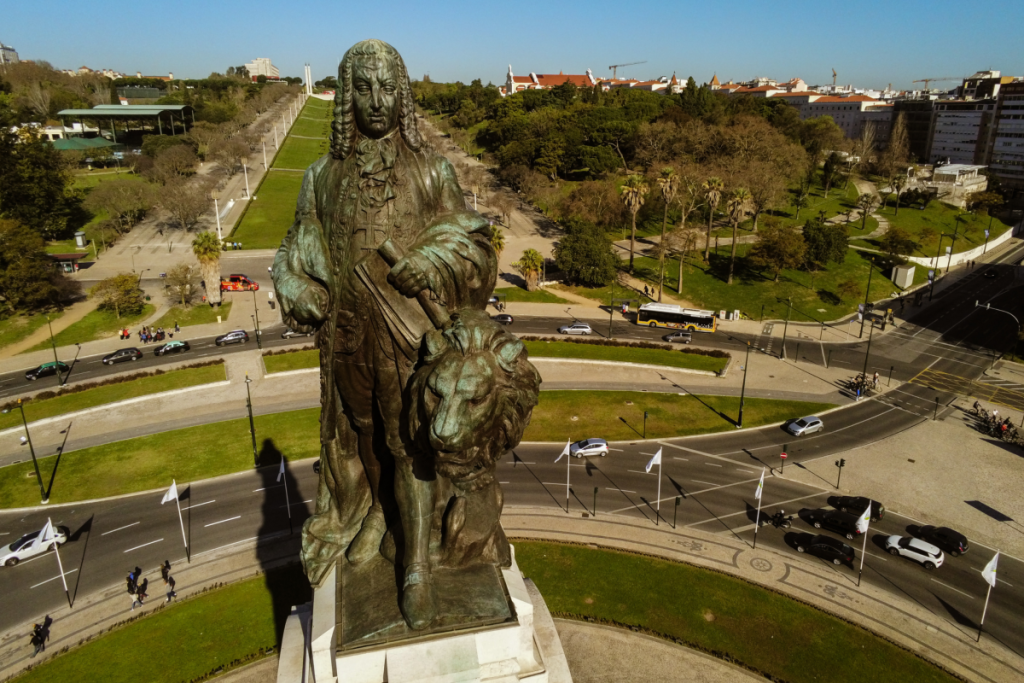

High up on the column, with a lion at his side, he looks down on the city. Those who walk around the Marquês Roundabout rarely look up, but few figures have left such a mark on Lisbon as Sebastião José de Carvalho e Melo, the Marquis of Pombal. When, on November 1, 1755, an earthquake leveled much of the city, it was he who took charge and brought it back to life. The Baixa district we walk through today, with its straight streets and facades that seem to repeat themselves, was born from that plan.
The day the earth shook in Lisbon
It was All Saints’ Day. The earthquake was followed by a tsunami, with waves estimated to have reached six to nine meters, and a fire that was not extinguished until about six days later, according to National Geographic. According to Britannica, two-thirds of Lisbon was reduced to rubble.
How many died? Even today, no one knows for sure. The most commonly cited estimates put the number of victims at around 20,000, but some suggest it was several tens of thousands. Even the earthquake’s magnitude continues to be studied: for a long time, a magnitude between 8.5 and 8.9 was taken as a given, but a study by the Instituto Superior Técnico estimated it at 7.7, according to DN.

Carvalho e Melo was then a minister under King José and wasted no time. He mobilized troops, secured supplies, set up makeshift shelters and hospitals, and by the very next day, he already had plans to rebuild the city. A phrase has become associated with him—“bury the dead and care for the living”—but it is not certain that he actually said it: tradition also attributes it to the Marquis of Alorna.
A Baixa designed to withstand earthquakes
For the new Lisbon, Manuel da Maia drew up the plan, and the military engineers Eugénio dos Santos and Carlos Mardel brought it to life. Where medieval alleyways once wound their way through the city, a grid of straight streets emerged, with standardized facades and mass-produced elements, almost like an assembly line. Hidden within the walls lay the great innovation: the Pombaline frame, a wooden structure designed to ensure the buildings could withstand earthquakes.
It’s no wonder that, in the nomination of “Pombaline Lisbon” for UNESCO’s Tentative List, submitted by Portugal in 2017, Baixa is described as the first modern city in the West, and the “cage” as the most advanced earthquake-resistant system of the 18th century.
The investigation that turned the earthquake into a scientific case
In addition to rebuilding, it was necessary to understand what had happened. On January 26, 1756, Carvalho e Melo sent the bishops of the kingdom a questionnaire with 13 questions about the earthquake. Many consider this the starting point of modern seismology, as noted by Lisbon Quake.
From power to exile and, finally, to the top of the roundabout

Born on May 13, 1699, Carvalho e Melo served as a diplomat in London and Vienna before King José appointed him minister in 1750. He quickly became the most powerful man in the kingdom: he was made Count of Oeiras in 1759 and Marquis of Pombal in 1769, and until 1777 he effectively ruled the country. Those were also the years of the Távoras trial and the expulsion of the Jesuits.
With the death of King José in 1777, the marquis fell from grace. Accused of abusing his powers, he was found guilty and banished from Lisbon, and he spent his final days in Pombal, where he died on May 8, 1782.
The statue unveiled on the marquis’s birthday
The monument took a long time to be completed. The cornerstone was laid in 1917, but it was not inaugurated until May 13, 1934—precisely on the day the marquis would have turned 235. The statue was designed by sculptor Francisco Santos, a former Sporting player, according to DN. From high above, Pombal continues to look down on the city he helped rebuild.
Don’t miss out! Follow us on Facebook, Instagram, and now on WhatsApp too!