

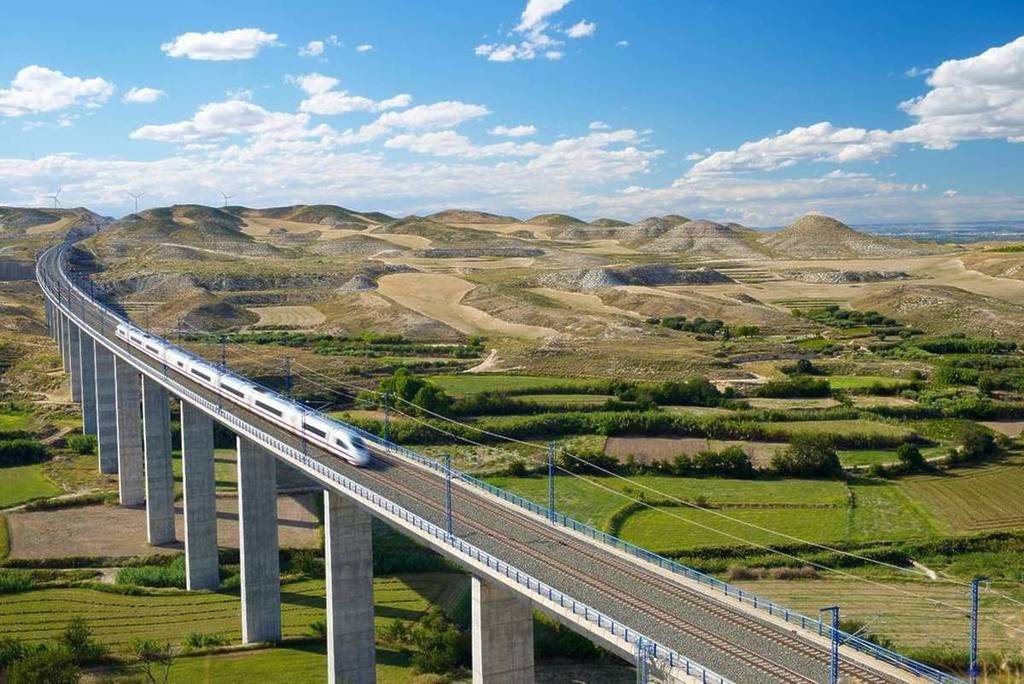
About 600 kilometers is the distance between the two Iberian capitals: Lisbon and Madrid (Spain). However, currently, traveling by train between the two cities can be a real hassle, taking more than nine hours (with several transfers). However, it seems that there is news about improving the Lisbon-Madrid rail link.
According to a note published on the Government Portal, Portugal and Spain have taken a decisive step by defining a set of concrete actions that will bring Lisbon and Madrid closer together. In a first phase, the aim is to establish rail links with a journey time of around 5 hours by 2030 ; and a link of up to around 3 hours by 2034 .

Strategy to 2030
The first big step in this Portuguese-Spanish partnership is set for the end of the decade, with direct journeys between Lisbon and Madrid taking a maximum of 5 hours.
In order to achieve this goal, other projects will have to be carried out through the creation of non-existent infrastructures and/or the elimination of various ‘bottlenecks’.
On the Portuguese side, one of the main commitments lies in the completion of the new high-speed line between Évora and Caia (scheduled for operation next year). At the same time, it is important to decongest Lisbon with the start and completion of the second track between Poceirão and Bombel (by 2030). It is also important to finalize the studies for the new Lisbon-Evora line, including the Third Crossing over the Tagus.
On the Spanish side, in order to support the project to strengthen Lisbon-Madrid rail links, it is important that the Plasencia-Talayuela section comes into operation (by 2028).

What about the goals up to 2034?
If everything goes according to plan between the two Iberian governments, there are still other goals to be taken into account, this time by 2034, with the highlight being the possible direct journey between the two capitals in around 3 hours.
On the Portuguese side, the commitments include the construction of the new Lisbon-Evora high-speed line, including the Third Crossing over the Tagus. On the ‘nuestros hermanos’ side, studies and possible construction of the new high-speed section between Caia and Badajoz and the Elvas-Badajoz International Railway Station are expected to begin .
In addition, the implementation of theEuropean Rail Traffic Management System ( ERTMS) is expected on several stretches between the two Iberian capitals.
The end of the Iberian gauge?
One of the central aspects of these initiatives is the possible replacement of the Iberian gauge. What does this mean?
As explained on the Portuguese Government Portal, the two countries have undertaken to analyze, by 2027, the socio-economic costs and benefits related to the possible transition from the Iberian to the European standard gauge.
If these measures are implemented within the planned timeframe, it will mean a major step forward for Lisbon and Madrid, not only in terms of bringing them closer together and reducing travel times, but also in terms of sustainability. This is because it will help to reduce greenhouse gas emissions and more.
Don’t miss out! Follow us on Facebook,Instagram and now WhatsApp too!